 Twitter
Australian businesses considering AI often come across two similar terms: AI agents and chatbots. While both can communicate with users, they are designed for different types of work.
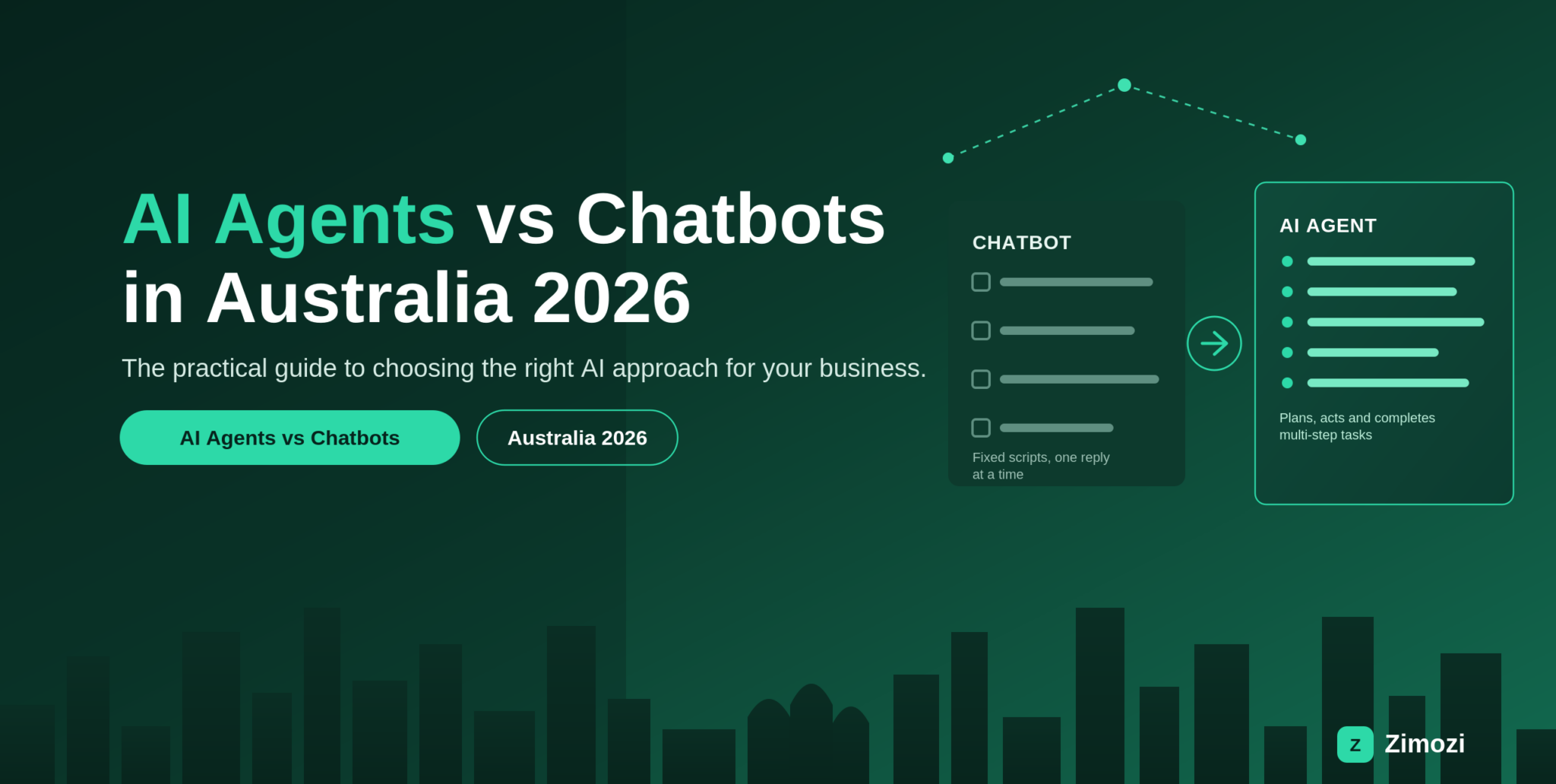
A chatbot is mainly used to answer questions, provide information, and communicate with customers. An AI agent can go further by using connected tools and business systems to complete defined tasks.
Understanding the difference between AI agents vs chatbots can help Australian businesses choose the right technology for their needs. If you need a tool to answer common customer questions, a chatbot may be enough. If you want to automate a multi-step workflow involving different systems, an AI agent may be more suitable.
What Is a Chatbot?
A chatbot is software that communicates with users through a website, application, messaging platform, or another digital channel.
Modern AI chatbots can understand natural language and generate responses based on the information available to them. They can also be connected to business information such as FAQs, product details, policies, documentation, and service information.
For example, an Australian business could use a chatbot to answer questions such as:
- What are your business hours?
- How long does delivery take?
- What is your return policy?
- Which service is suitable for my business?
- How can I contact your support team?
A chatbot can also collect initial information from a customer and transfer the conversation to a staff member when human assistance is required.
For businesses that mainly need customer communication and information sharing, a chatbot can be a practical solution.
What Is an AI Agent?
An AI agent is designed to do more than respond to a user’s message. It can be connected to business systems and given specific instructions, permissions, and tasks.
Depending on how it is designed, an AI agent can interact with tools, retrieve information, perform defined actions, and support multi-step workflows.
For example, consider an Australian wholesale business that receives an email from a customer asking about a delayed shipment.
A chatbot could explain the company’s normal delivery timeframes and direct the customer to the support team.
An AI agent could potentially:
- Identify the customer’s order number.
- Check the order status in the inventory system.
- Retrieve tracking information from the freight provider.
- Check relevant customer information in the CRM.
- Prepare an update using the information it finds.
- Send the response or request staff approval before sending it.
The important difference is that the agent is participating in a business workflow rather than only providing information.
The difference between AI agents vs chatbots becomes clearer when we look at how they handle tasks, integrations, and automation.
AI Agents vs Chatbots: Key Differences
When comparing AI agents vs chatbots, businesses should consider several practical differences.
Purpose
Chatbots are generally designed for communication, customer support, and information retrieval.
AI agents are designed to support task execution and workflow automation. They can be given a defined goal and use connected tools to complete specific steps.
System Integrations
A chatbot may work with a website, knowledge base, FAQs, or customer support platform.
An AI agent may need to connect with several business systems, such as:
- CRM software
- Accounting platforms
- Inventory systems
- Databases
- Customer support platforms
- Internal business applications
- External APIs
The more systems an AI agent needs to access, the more important integration design, authentication, permissions, and security become.
Level of Autonomy
A chatbot generally responds when a user sends a message.
An AI agent can potentially determine which defined steps are needed to complete a task and use available tools to perform those steps.
However, greater autonomy also requires greater control. Businesses should decide which actions can happen automatically and which actions require human approval.
Implementation Requirements
A basic chatbot can often be built around existing website content, FAQs, documentation, or a knowledge base.
An AI agent generally requires more technical planning. Depending on the use case, development may involve:
- API integrations
- Authentication
- Access permissions
- Workflow design
- Data management
- Testing
- Monitoring
- Error handling
- Human approval processes
This means an AI agent can require more development and maintenance than a basic chatbot.
When Is a Chatbot a Better Fit?
When deciding between AI agents vs chatbots, businesses should first consider what they actually want to automate.
A chatbot can be suitable when the main requirement is customer communication.
Common use cases include:
- Answering frequently asked questions
- Providing information outside business hours
- Guiding website visitors
- Helping customers find products or services
- Collecting initial enquiries
- Directing customers to the appropriate team
- Providing basic customer support
For example, a business that receives questions about opening hours, delivery times, pricing information, or return policies may use a chatbot to provide quick answers.
If the process ends after the customer receives the required information, a chatbot may provide everything the business needs.
When Is an AI Agent a Better Fit?
An AI agent may be more appropriate when a process involves multiple steps, business systems, or repeated manual work.
Potential use cases include:
- Checking information across multiple systems
- Preparing routine reports
- Updating business records
- Collecting information for employees
- Preparing customer responses
- Supporting internal workflows
- Retrieving information from different applications
- Automating defined administrative tasks
For example, an employee may need to check a CRM, an order management system, and an accounting platform before responding to a customer.
Instead of manually checking each system, an AI agent could potentially retrieve the required information and prepare the response for the employee.
The suitability depends on the systems involved, the quality of the available data, the required permissions, and the consequences of an incorrect action.
Businesses comparing AI agents vs chatbots should first identify the type of task they want to automate.
Privacy and Data Considerations in Australia
Businesses using AI should carefully consider how information is collected, used, stored, accessed, and shared.
This becomes particularly important when an AI system is connected to customer records, employee information, financial information, or other sensitive business data.
Before implementing an AI agent or chatbot, businesses should consider:
- What information does the AI system need to access?
- Which systems can it connect to?
- Who can access the information?
- What actions is the AI allowed to perform?
- Where is the information processed and stored?
- Which actions require human approval?
- How will access and activity be monitored?
Australian businesses should also consider applicable privacy requirements, including the Australian Privacy Principles where relevant.
Businesses using AI systems that handle personal information should also review the OAIC guidance on privacy and commercially available AI products
Privacy and security requirements should be considered during the design of the system rather than added after implementation.
Human Oversight Still Matters
AI automation does not necessarily mean removing people from the process.
For some business tasks, human review can provide an important control.
For example, an AI agent could prepare an invoice but require an employee to approve it before the invoice is issued.
Similarly, an agent could prepare a customer response based on information from different systems while a staff member reviews the response before it is sent.
Human approval can be particularly important when an automated action could have financial, legal, privacy, or significant customer consequences.
Businesses should define clear boundaries around what the AI can do independently and what requires human involvement.
The choice between AI agents vs chatbots also depends on the systems, data, and permissions required.
Start With a Clearly Defined Use Case
Businesses do not need to automate an entire department or business process at once.
A better starting point is to identify one specific and repeatable task.
For example:
Customer enquiry → Retrieve information → Check business system → Prepare response → Human approval
Once the workflow is clearly understood, the business can determine whether a chatbot, AI agent, traditional automation, or a combination of technologies is appropriate.
Starting with a defined use case also makes it easier to:
- Set clear requirements
- Define system permissions
- Test the workflow
- Identify potential errors
- Measure the results
- Decide where human involvement is required
AI Agents and Chatbots Can Work Together
The choice does not always have to be between an AI agent and a chatbot.
Businesses can use both technologies as part of the same workflow.
For example, a customer could ask about an order through a website chatbot. The chatbot can collect the required information, while an AI agent connected to the relevant business systems retrieves the order status and prepares a response.
In this type of setup, the chatbot handles the conversation while the AI agent supports the underlying workflow.
The important part is to clearly define what each component is responsible for and what information or actions it is allowed to access.
For many businesses, understanding AI agents vs chatbots is the first step toward selecting an appropriate AI solution.
How Zimozi Can Help
Zimozi works with Australian businesses on AI and Machine Learning solutions, custom software, web development, and digital products.
Its capabilities include AI applications development, AI-driven solutions, MVP development, web development, and software solutions designed around specific business requirements.
For a business considering an AI agent or chatbot, the first step is to understand the workflow, existing software, data requirements, integration needs, and level of automation required.
Zimozi can help businesses assess these technical requirements and develop a focused solution around a clearly defined use case.
Conclusion
The choice between AI agents vs chatbots depends on what you want the technology to do.
A chatbot can be suitable for answering questions, providing information, and handling basic customer interactions. An AI agent can be more appropriate when a workflow involves multiple steps, connected systems, and controlled task execution.
Before implementing either solution, businesses should consider privacy, security, permissions, integrations, testing, and human oversight.
Before implementing AI agents vs chatbots, businesses should consider security, privacy, integrations, and human oversight.
If you are considering a chatbot or AI agent for a specific business workflow, Zimozi can help you define a practical solution and assess the technical requirements.