 Twitter
When an Australian startup decides to build a mobile application, one of the earliest technical choices is React Native vs Flutter, the two leading cross platform frameworks, versus building fully native apps.
In Australia, mobile users are divided almost evenly between iOS and Android. Apple devices account for roughly fifty five percent of the market, while Android devices represent forty five percent, according to StatCounter.
Building separate native applications in Swift for iOS and Kotlin for Android means paying for two separate codebases. In cities like Sydney and Melbourne, where senior engineering salaries are high, this doubles initial development expenses and slows release cycles.
Cross platform frameworks solve this problem by allowing a single engineering team to write code once and deploy it to both the Apple App Store and Google Play Store.
Today, two frameworks dominate cross platform mobile app development: React Native and Flutter. The React Native vs Flutter decision is one of the most important technical calls a startup makes early on. Both can produce fast, reliable applications, but they work on different architectural principles. Choosing the right one depends on your team’s existing skills, your UI/UX design requirements, and your long term product roadmap.
How React Native Works
React Native was developed by Meta and has been in production since 2015. It uses JavaScript and TypeScript, which are the most common programming languages in modern web development.
The defining characteristic of React Native is that it uses genuine native user interface components.
When you create a button or text field in React Native, the framework renders an authentic iOS button on an iPhone and an authentic Android button on an Android device.
Modern React Native versions use the Hermes JavaScript engine and the JavaScript Interface, known as JSI. This allows JavaScript code to communicate directly with native platform code without the latency of older JSON serialization bridges.
For startups that already run a web application built on React or Next.js, React Native allows developers to share TypeScript data models, API client logic, and validation rules between web and mobile platforms.
Because React Native relies on native operating system controls, applications feel familiar to users who expect platform specific gestures and navigation patterns.
How Flutter Works
Flutter was created by Google and released in 2018. Unlike React Native, Flutter does not wrap native system components. Instead, it ships with its own rendering engine and draws every button, menu, and pixel directly onto the screen canvas.
Flutter uses the Dart programming language, an object oriented language that compiles directly to native ARM machine code.
Because Flutter controls every pixel on the screen, an interface looks completely identical on every device and operating system version.
Flutter uses a reactive widget tree where layout, styling, and structural elements are all widgets. This makes it straightforward to build complex, animated, or custom UI/UX layouts that do not rely on standard system controls.
The rendering engine, known as Impeller on iOS, compiles shaders ahead of time. This minimizes animation stutter during screen transitions and complex gestures.
The main trade off with Flutter is language adoption. Dart is an efficient language, but it is rarely used outside the Flutter ecosystem. Australian engineering teams typically have fewer Dart developers than JavaScript or TypeScript developers.
Architectural Comparison: React Native vs Flutter
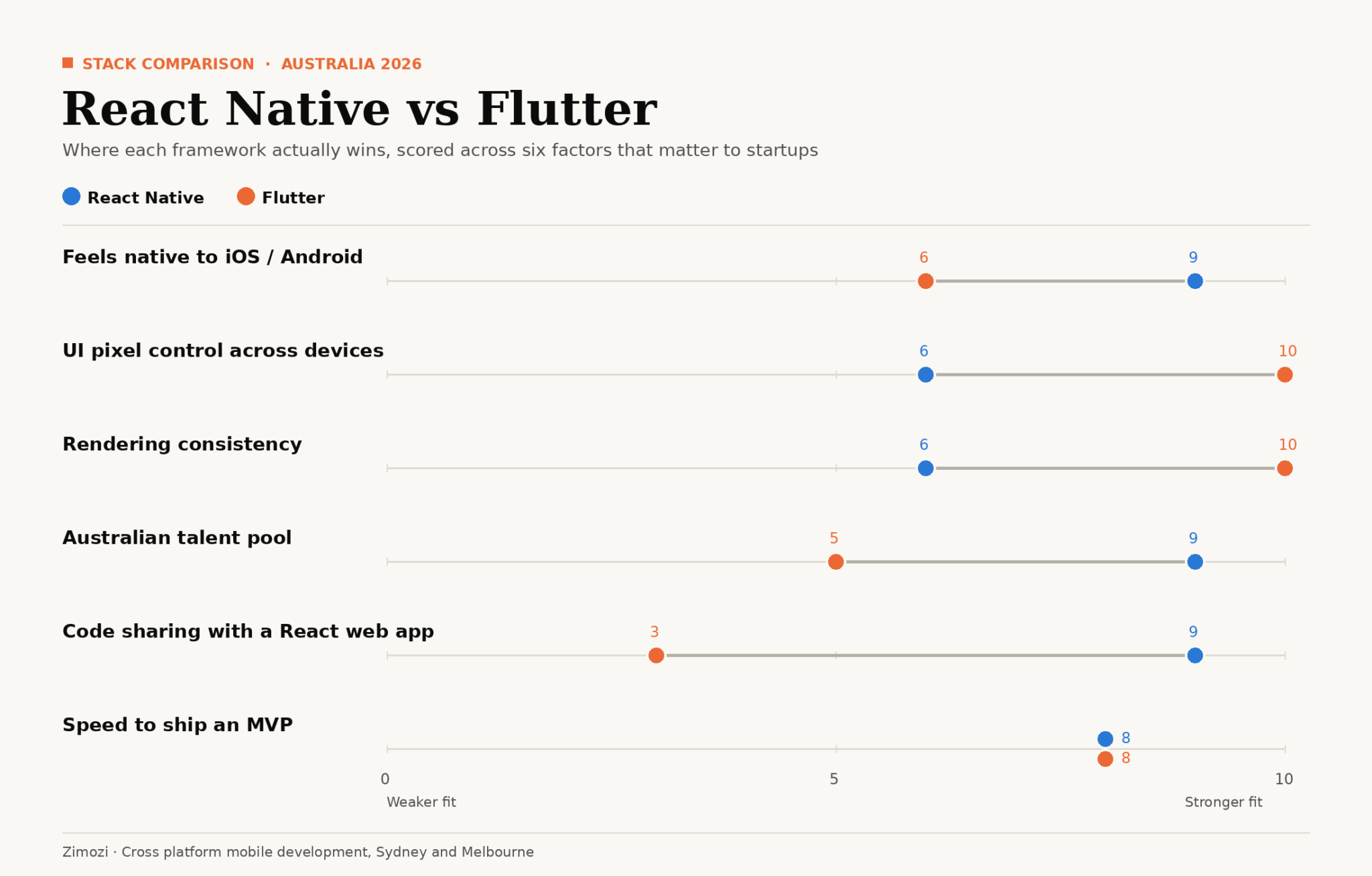
To evaluate the React Native vs Flutter question for your product, consider how the two frameworks handle key technical and operational requirements.
| Technical Factor | React Native | Flutter |
|---|---|---|
| Primary Language | TypeScript and JavaScript | Dart |
| User Interface Layer | Native platform primitives (UIKit and Android Views) | Proprietary rendering engine (Impeller/Skia) |
| Performance | Near native with Hermes engine and JSI | Consistent high frame rate rendering |
| Code Sharing with Web | High: can share logic and design tokens with React web apps | Moderate: Flutter web exists but uses a separate canvas model |
| Initial Binary Size | Smaller baseline package size | Slightly larger baseline package due to embedded engine |
| Australian Talent Pool | Broad: large pool of TypeScript developers in Sydney and Melbourne | Focused: dedicated Flutter community, smaller overall talent pool |
Performance and User Experience
In earlier years, cross platform apps had a reputation for sluggish scrolling and delayed touch responses. In 2026, both frameworks easily achieve sixty frames per second on standard hardware when built correctly.
The practical difference lies in how interfaces are designed and maintained.
When React Native is the Better Fit
React Native is usually the preferred choice when your application needs to feel native to each operating system. If your product relies on standard system menus, platform specific accessibility tools, or close integration with device hardware like Bluetooth and background location tracking, React Native provides mature third party libraries.
It is also the natural choice if your business already operates a React web platform, because your existing engineering team can contribute to the mobile codebase without learning a new language.
When Flutter is the Better Fit
Flutter excels when your brand requires a bespoke, highly stylized user interface that must look identical across every phone, tablet, and operating system version. Fintech dashboards with dynamic custom graphs, interactive consumer applications, and platforms with heavy custom animations often benefit from Flutter’s predictable canvas rendering.
Local Considerations for Australian Startups
When building a mobile product in Australia, founders and CTOs should consider three local factors.
Developer Availability and Hiring Costs
In major tech hubs like Sydney, Melbourne, and Brisbane, hiring specialized app developers is a major budget line. Because TypeScript is widely taught and used, finding or contracting React Native developers is generally faster than sourcing experienced Dart developers. This makes team scaling easier if your startup grows rapidly.
Compliance and Local Integrations
Australian mobile apps must adhere to the Privacy Act 1988, Australian Privacy Principles, and Apple App Tracking Transparency guidelines. Both frameworks support encrypted local storage, such as iOS Keychain and Android Keystore, and connect securely to Australian payment gateways and identity verification providers.
App Store Approval and Maintenance
Both frameworks produce standard binary packages, .ipa for iOS and .aab for Android, that comply with Apple App Store and Google Play Store review requirements. Maintaining a single cross platform codebase means your team pushes security patches and feature updates to both platforms simultaneously, reducing maintenance overhead.
Making the Decision: React Native vs Flutter for Your Startup
For most early stage Australian startups, the React Native vs Flutter decision comes down to two questions.
Do you already have a web application built in React or TypeScript? If yes, React Native usually provides the fastest delivery and the highest code reuse.
Does your product rely on an entirely unique, brand specific design that must look identical on every screen? If yes, Flutter gives your design team complete control over every pixel.
Either framework allows you to validate your product with real Australian users on both operating systems at roughly half the cost of building two separate native applications.
React Native vs Flutter: Quick FAQ
Is React Native or Flutter faster for an MVP?
Both frameworks let a small team ship to iOS and Android from one codebase, so speed usually comes down to your team’s existing skills rather than the framework itself.
Which framework has more developers available in Australia?
React Native, since it uses TypeScript and JavaScript, languages that are already common among Sydney and Melbourne engineering teams.
Can I switch from Flutter to React Native later, or the reverse?
Technically yes, but it means rebuilding the UI layer from scratch, so most teams choose carefully at the start rather than planning to switch.
Do both frameworks support Australian payment and identity providers?
Yes. Both React Native and Flutter can connect securely to local payment gateways and identity verification services used by Australian businesses.
How Zimozi Supports Mobile Development in Australia
Zimozi designs and builds custom software and mobile applications for startups and growing businesses across Australia. Our mobile app developers build cross platform applications in both React Native and Flutter, pairing clean architecture with user centered UI/UX design.
We deliver projects through defined scopes, milestone based pricing, and weekly working demos, giving founders full visibility into their build from the first sprint.
If you are still weighing React Native vs Flutter for your mobile application, we can help assess your technical specifications and provide an objective recommendation. Would you like to discuss your mobile roadmap?