 Twitter
Agentic AI goes a step beyond the chatbot. Instead of only answering questions, it can carry out tasks across business software. For Australian small and medium businesses, that could mean taking on repetitive back-office work, such as processing orders. This post explains the key terms, walks through one example and covers the security points to think about first.
What the terms mean
A Large Language Model (LLM) is software that reads, analyses and writes text. A custom LLM is set up to work with one company’s information, such as policy documents, past contracts or product manuals.
Agentic AI refers to programs, often called AI agents, that can take actions instead of only giving answers. An agent can follow a series of steps across different software systems to finish a task. Our guide to prompt engineering explains how instructions shape what these models do.
An example: processing purchase orders
Take an Australian wholesale distributor that receives dozens of purchase orders by email each day. Today, a staff member reads each email, checks stock in the warehouse system, enters the order into the accounting software and replies to the customer.
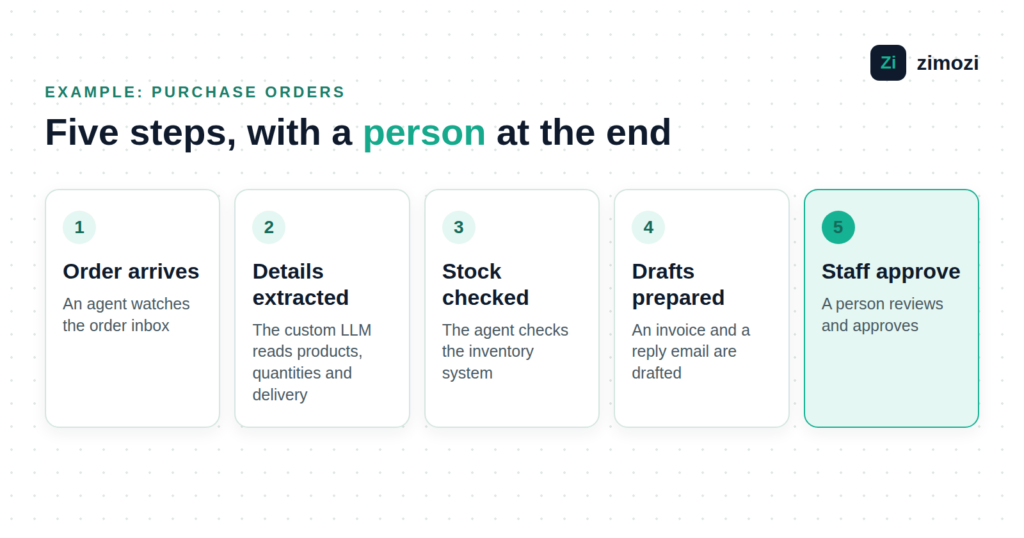
With agentic AI, the same process could work in five steps:
- The agent watches the order inbox.
- The custom LLM pulls out the product names, quantities and delivery details.
- The agent checks stock levels in the inventory system.
- If the items are available, it drafts an invoice in the accounting software and prepares a reply email.
- A staff member reviews the drafts and approves them.
This is an illustration of how such a process could be set up, not a description of a specific customer. The details would depend on the systems the business already uses, and connecting them takes careful planning.
Security and oversight
Connecting agentic AI to core business systems needs care. Sensitive business data should stay in a secure environment and not be entered into public AI tools. Australian businesses should also check their obligations under the Privacy Act 1988 and read the OAIC guidance on commercially available AI products. Our cybersecurity compliance checklist for Australian SMEs is a useful place to start on the wider security picture.
Keep a person in the loop. Agents should draft documents and prepare actions for approval. Final invoices and financial decisions should stay with your staff. That keeps the business in control and makes mistakes easier to catch. Ask who reviews the agent’s work, how mistakes are reported, and what happens when the agent is unsure. Clear answers to these questions make the system easier to trust and easier to improve.
Where to start with agentic AI
Good first tasks tend to share a few traits. The task repeats often, the steps are clear, the inputs are mostly text, and a mistake is easy to spot and fix. Sorting incoming enquiries or preparing draft replies are examples. Tasks that involve large payments or legal decisions are a poor first choice.
Begin with one process and check how it goes before adding more. If you are also thinking about AI inside an app, our post on AI in mobile apps for Australian businesses covers that side.
Building with Zimozi
Zimozi builds custom web and mobile applications, SaaS products, and AI agents with workflow automation. We also connect new tools to existing and older software through system integrations. For agentic AI, we suggest starting with one clearly defined process, such as sorting incoming orders, and not a whole department.
If you are considering a similar application, Zimozi can help define a small first version and assess the technical requirements. Would you like to discuss the idea?