 Twitter
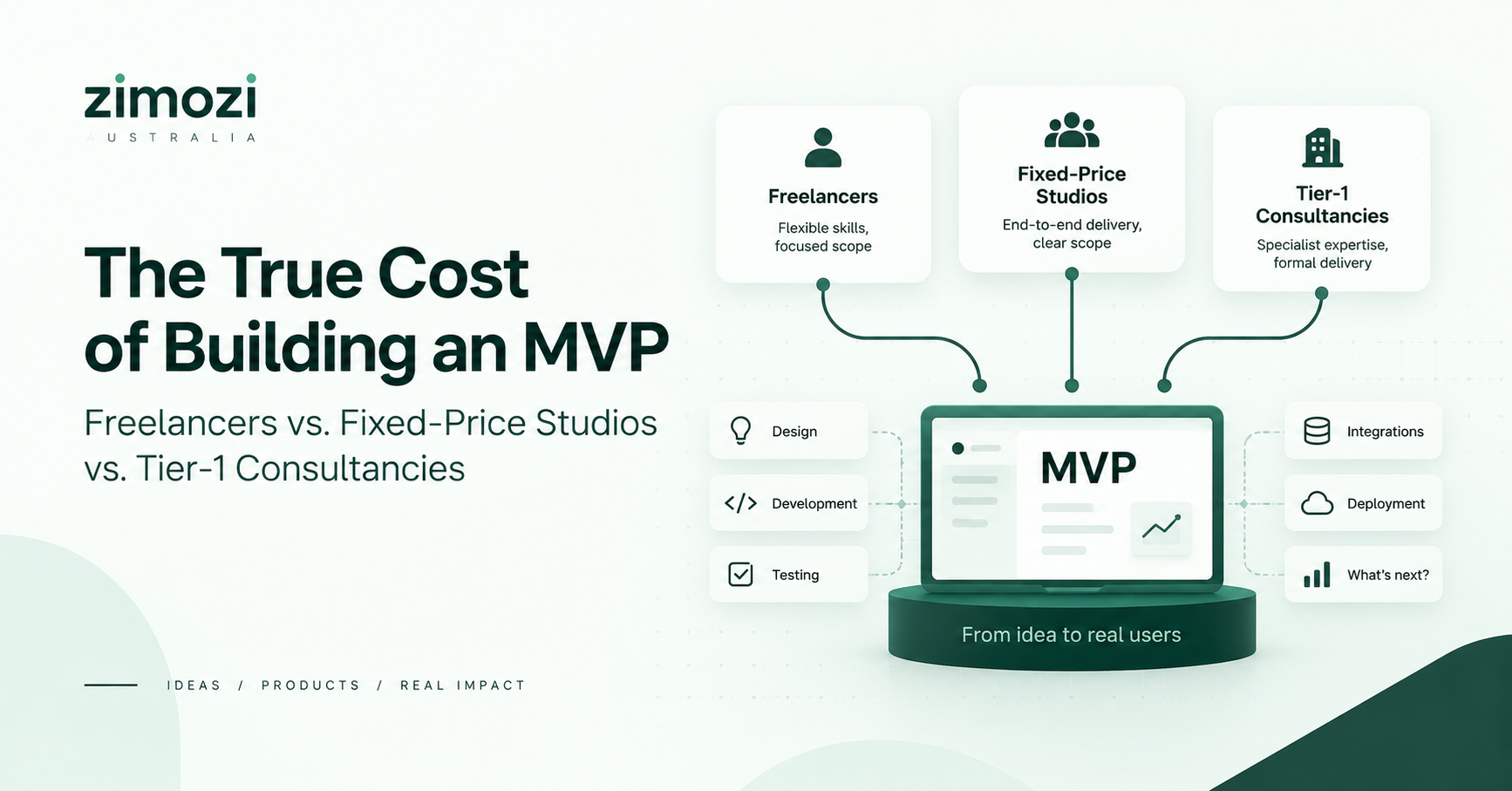
MVP development cost Australia is the first practical question founders ask before they start building. This article breaks down what an MVP typically costs in 2026, what drives the price up or down, and what to watch for beyond the initial quote.
What Counts as an MVP
An MVP is the smallest working version of your product that lets real users test it. It is not a prototype and it is not the finished product. The goal is to validate whether the idea works in the real world, with just enough features to make that possible, before investing in a larger build.
A well scoped MVP usually includes user login, one or two core features that solve the main problem, a simple interface, and a basic backend to support it. Everything else can wait.
If you are still shaping the idea itself, our guide to MVP scoping and planning walks through how to narrow a concept down to its essentials.
What Drives MVP Development Cost in Australia
A few factors decide where your project lands on the price scale.
Feature complexity. A simple booking flow costs far less than a system with real time updates, payments, and multiple user roles. Each added feature means more design time, more backend logic, and more testing.
Platform choice. A single web app is cheaper to build than a native app for both iOS and Android. Cross platform frameworks can reduce this gap but do not remove it entirely.
Design requirements. A clean, functional interface costs less than a fully custom design system with animations and detailed UX research.
Who builds it, and where. In Australia, local developer rates typically sit around AUD 100 to 200 per hour, depending on seniority and specialisation. Senior contractors in fields like React or backend architecture often charge at the higher end of that range. Offshore or hybrid teams can bring the hourly rate down significantly, though this changes how you manage communication and quality control.
Integrations and compliance. Payment gateways, third party APIs, and anything touching personal data (which in Australia means considering Privacy Act obligations) add both time and cost.
Together, these factors are what shape MVP development cost Australia project by project. No two builds land on the same number because no two scopes are the same.
Realistic MVP Development Cost Australia Ranges for 2026
Based on current market rates, here is a practical breakdown of MVP development cost Australia by project type.
Basic MVP
A single core feature, one platform, simple login and dashboard. Think of a basic booking tool or a content listing app.
Typical range: AUD 25,000 to 40,000
Typical timeline: 4 to 8 weeks
Standard MVP
Multiple features, a proper backend, some integrations such as payments or notifications, and a more considered design.
Typical range: AUD 40,000 to 80,000
Typical timeline: 8 to 12 weeks
Advanced MVP
AI features, real time data, multiple integrations, or compliance requirements such as handling sensitive personal or financial data.
Typical range: AUD 80,000 to 150,000 or more
Typical timeline: 12 to 18 weeks
These ranges are general estimates drawn from current industry pricing, not fixed quotes. Your actual MVP development cost Australia number depends entirely on scope. See our full range of development services for how we approach each tier.
A Practical Example
Say a founder wants to build an MVP for a local trades booking platform. Customers post a job, tradespeople bid on it, and the winning bid gets booked and paid through the app.
At a basic level, this needs user accounts for two different user types, a job posting form, a bidding interface, and a simple payment flow. That alone pushes the project into the standard tier, likely AUD 45,000 to 65,000, because you now have two user roles, a matching or bidding system, and payment processing to handle securely.
If the founder later wants automated job matching based on location and trade type, or in app messaging, those are reasonable additions for a version two, not necessarily the first MVP. Keeping the first release narrow is usually the difference between a manageable budget and a stalled project.
Costs That Often Get Missed
A quote for development work is not the whole picture. A few things worth planning for early:
- Ownership of the code and IP. Confirm in writing that you own everything built, not just a license to use it.
- Testing and QA. This is often underestimated and can add real time to a project if it is not scoped in from the start.
- Hosting and infrastructure. Ongoing cloud costs are separate from the build cost.
- Post launch maintenance. Bug fixes, security updates, and small improvements after launch typically run at 15 to 20 percent of the original build cost per year.
- Security, particularly for anything handling payments or personal data. This should be part of the build, not an afterthought.
Keeping MVP Development Cost Australia Under Control
The most reliable way to manage MVP development cost Australia is to keep the scope narrow and specific. It is tempting to build in every feature you can imagine for version one, but each addition adds weeks and dollars. A tightly scoped MVP that answers one clear question, whether people will actually use this, gets you to real user feedback faster and cheaper than a feature heavy first release.
It also helps to be clear about your delivery model upfront. A local Australian team, an offshore team, or a hybrid of both will each affect your budget differently, and there is no single right answer. It depends on how hands on you want to be and how much you value having a team in your own time zone.
Where Zimozi Fits In
Zimozi works with founders and businesses across custom web and mobile applications, SaaS product development, AI agents and workflow automation, system integrations, and fintech and digital product development. For an MVP, this usually means helping define a realistic scope first, then building a working version with a clear path to add features once the idea is validated.
If you are weighing up an MVP idea and want a clearer sense of what it would actually take to build, Zimozi can help define a small first version and assess the technical requirements. Would you like to talk through your idea?
Before you publish, replace these three placeholder links with your real page URLs:
PLACEHOLDER-scoping-pagePLACEHOLDER-services-pagePLACEHOLDER-contact-page
Everything else (external dofollow links, focus keyword placement, title sentiment word, image alt text) is ready to go as is.