 Twitter
Website development cost Australia figures are not fixed, and they vary more than most business owners expect. Ask five Australian agencies to quote the same project and you will get five different numbers, sometimes tens of thousands of dollars apart. That is not agencies padding their margins. It is because “a website” or “an app” can mean a dozen different builds, and the price follows the scope, not the label on the brief.
Why Australian Build Costs Vary So Widely
Two businesses can both ask for “a new website” and end up with quotes that differ by a factor of ten. One wants a five-page brochure site to replace something built in 2019. The other wants a custom booking system with payments, staff logins and integrations into their existing accounting software. Both are technically websites. Only one of them is a five-figure job.
Australian SMEs typically spend somewhere between 1 and 7 percent of revenue on technology in a given year, with that figure climbing to 8 to 10 percent during a genuine digital transformation, such as replacing a manual process with a proper system for the first time. A new website or app is usually the single biggest line item in that budget, which is exactly why understanding website development cost Australia benchmarks matters before you ask anyone for a number.
Website Development Cost Australia: Typical Price Bands by Project Type
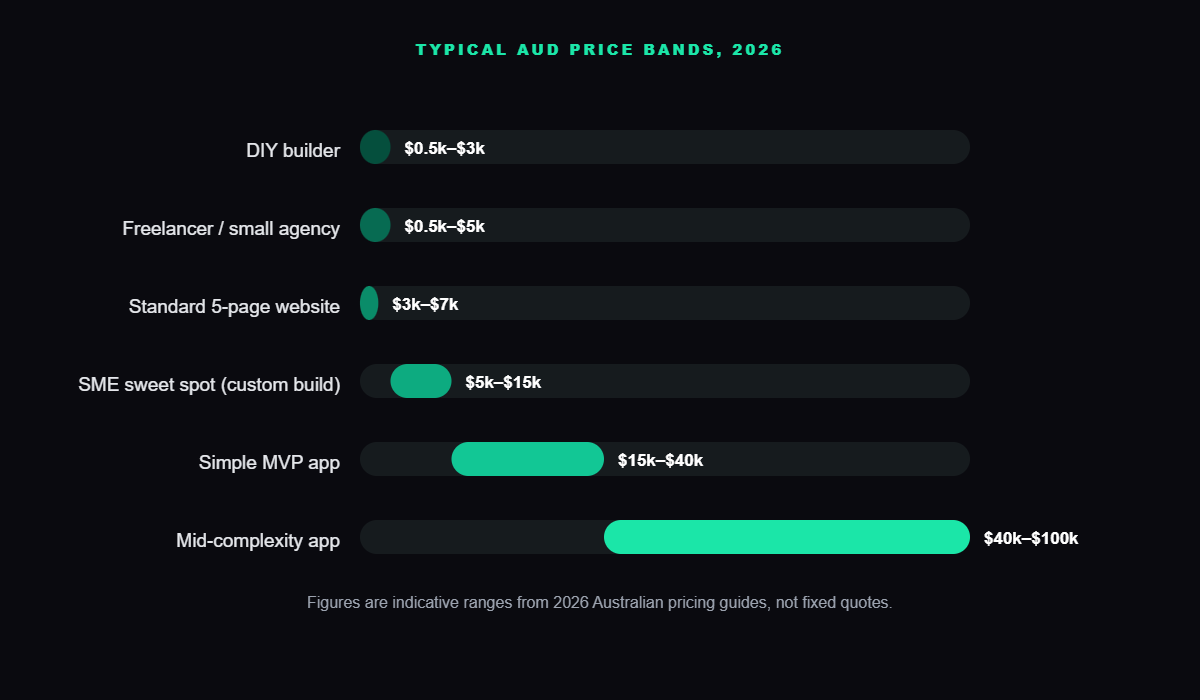
These website development cost Australia figures are indicative ranges drawn from 2026 pricing guides, not a fixed quote. Treat them as a starting point for a conversation, not a ceiling or a floor.
- Brochure or informational website (five to ten pages). A straightforward site with no custom functionality typically runs from $3,000 to $7,000 with a freelancer or small studio, or as little as a few hundred dollars on a DIY platform if you are prepared to build it yourself.
- Custom SME website (the common “sweet spot”). Once you add booking forms, a content management system your team can actually use, and a design that is not a template, most established Australian SMEs land between $5,000 and $15,000.
- Ecommerce site. Product catalogues, payment gateways, shipping rules and stock management push the number up again. This usually starts around where a custom SME site finishes and climbs from there depending on catalogue size and integrations.
- Simple MVP app. A single-platform app with a narrow feature set typically costs $15,000 to $40,000.
- Mid-complexity customer-facing app. Once you need admin dashboards, analytics, stronger branding and integrations with other systems, budget $40,000 to $100,000, with many SME apps landing in the $80,000 to $200,000 range once all of that is in scope.
What Actually Drives the Price Up
Inside any of those bands, a handful of specific decisions do most of the work in pushing website development cost Australia quotes from the low end to the high end.
- Integrations. Every system you connect, accounting software, a CRM, a payment gateway, a booking calendar, adds development and testing time. Two or three integrations can add as much to a budget as the base build itself.
- Compliance requirements. If your business handles personal or payment data, Privacy Act obligations and basic security controls need to be designed in from the start, not bolted on afterwards. Retrofitting security is almost always more expensive than building it in.
- Custom design. A template with your logo dropped in is cheap. A genuinely custom interface, with its own component library and original layouts, takes meaningfully longer to design and build.
- Scope changes mid-project. New features, design revisions and integrations that were never in the original brief are the most common reason a project’s final invoice does not match its opening quote.
In-House vs Agency vs Fractional Team
Once you know roughly what you want to spend, the next decision is who builds it.
In-house makes sense once you have enough ongoing development work to keep a developer or small team genuinely busy year-round. Below that threshold, you are paying a full salary for part-time output.
A traditional agency gives you a full team and a fixed scope, which is useful for a well-defined project with a clear end date. The trade-off is less flexibility once the project is underway, and agency day rates reflect the overhead of running a large studio.
A fractional team sits between the two. You get senior engineers for the hours you actually need, scaling up during a build and back down once you are in maintenance mode, without carrying a full-time headcount or paying for agency overhead you do not use.
Questions to Ask Before You Sign a Quote
A lower website development cost Australia quote is not automatically a better deal. Before you sign anything, ask:
- Does this quote include every integration I have mentioned, or are some “to be scoped later”?
- What happens to the price if I ask for a design revision after the first round?
- Who owns the code and the design files once the project is finished?
- What is included in the first three months after launch, and what counts as a paid change request?
- How are security and Privacy Act compliance handled, and is that built in or a separate line item?
- What does ongoing hosting, maintenance and support cost once the initial build is done?
Where Zimozi Fits In
When you compare website development cost Australia quotes, the number only tells part of the story until the scope is fixed. We work with Australian SMEs as a fractional engineering team: senior developers scoped to the size of your project, not a fixed agency package. That means a brochure site does not carry the overhead of a large studio, and a genuinely custom build gets the same senior attention a bigger client would expect.
Security and compliance are built into how we work rather than added at the end. If your project handles customer data or payments, our earlier guide on why penetration testing matters for Australian businesses is worth reading alongside this one, particularly if compliance costs are part of what you are budgeting for. For a broader starting point on what a business website needs to cover, business.gov.au’s guidance on setting up a business website is a useful reference before you brief any agency.
Whether you are scoping a straightforward brochure site or a full custom application, the fastest way to get an accurate number is a short conversation about what the build actually needs to do, not a generic quote based on a category label.
Book a Free Call and we will help you scope your project properly before you request a single quote.