 Twitter
A solid cybersecurity compliance checklist Australia SMEs can actually use is no longer optional. Cyberattacks against small and medium Australian businesses are not slowing down, and ransomware groups increasingly target smaller companies precisely because they assume nobody there is watching. In 2026, that assumption catches up with businesses that have treated cybersecurity as a someday project.
The regulatory environment has caught up too. The Notifiable Data Breaches scheme under the Privacy Act 1988 requires eligible businesses to report data breaches that are likely to cause serious harm, and the consequences for getting this wrong keep growing. For an SME owner, compliance is no longer a box to tick once a year. It is a set of habits that need to run continuously.
This checklist breaks down what an Australian SME actually needs in place in 2026, in plain terms, without the scare tactics.
Why Compliance Matters More in 2026
Two things have changed recently. First, attackers have gotten better at automating attacks on smaller targets, so the old assumption that “we’re too small to be worth it” no longer holds. Second, regulators and insurers now expect a documented baseline of controls, not just good intentions. A business that cannot show it took reasonable steps faces a harder conversation after a breach, with both the OAIC and its own customers.
None of this means an SME needs an enterprise security budget. It means the basics need to be in place, tested, and kept current.
Privacy Act Obligations, in Plain English
Most SME owners assume the Privacy Act only applies to big companies. That is not quite right. If your business has an annual turnover over $3 million, handles health information, or trades in personal information, you are very likely covered.
If you are covered, the Notifiable Data Breaches scheme applies. You need reasonable steps in place to protect personal information, you need to be able to detect a breach quickly, and if a breach is likely to cause serious harm, you must notify affected individuals and the Office of the Australian Information Commissioner (OAIC). “Reasonable steps” is deliberately broad, but regulators generally look at whether a business had basic controls such as access restrictions, encryption and an incident response plan, not whether it had a flawless system. The OAIC’s Notifiable Data Breaches guidance sets out exactly what counts as an eligible breach and how notification works.
The 2026 Cybersecurity Compliance Checklist Australia SMEs Need
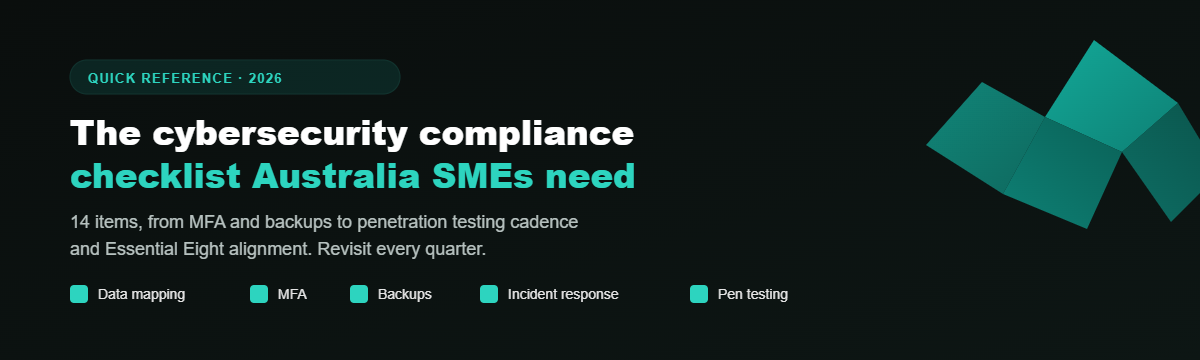
This cybersecurity compliance checklist Australia SMEs can lean on is meant to be a working document, not a once-a-year audit. Revisit it every quarter.
- Data mapping. Know what personal and financial data you hold, where it lives, and who can access it. You cannot protect what you have not mapped.
- Multi-factor authentication (MFA). Turn it on for email, admin accounts, and any system holding customer data. This one control blocks the majority of account-takeover attempts.
- Access control. Staff only have access to the systems and data their role requires. Review access whenever someone changes roles or leaves.
- Backups. Automated, tested regularly, and stored separately from your main network so ransomware cannot reach them too.
- Incident response plan. A short, written plan that says who does what in the first 24 hours of a suspected breach, including who notifies the OAIC if required.
- Vendor risk checks. Any third party that touches your customer data, such as payment processors, marketing tools or hosting providers, should be reviewed for its own security practices.
- Staff training. Short, regular sessions on phishing recognition and password hygiene. Most breaches still start with a clicked link.
- Patch management. Keep operating systems, plugins and software current. Unpatched software remains one of the most common entry points.
- Encryption. Apply it to data at rest and in transit, particularly anything containing customer or payment details.
- Penetration testing cadence. At least annually, or after any major system change, to find the gaps your own team cannot see from the inside.
- Device management. Work laptops and phones covered by basic endpoint protection and remote wipe capability.
- Privacy policy review. Confirm your published privacy policy actually reflects what data you collect and how you use it, not a template from a few years ago.
- Cyber insurance. Sized to your business and understood well enough that you know what it does and does not cover.
- Essential Eight alignment. Even partial alignment with the ACSC’s Essential Eight strategies puts you ahead of most SMEs in your position.
Common Mistakes Australian SMEs Make
A few patterns show up again and again when SME owners talk through their security posture.
- Treating compliance as a document exercise. A privacy policy on the website means little if the actual data handling behind it does not match what the document says.
- Assuming size makes them a low target. Attackers increasingly favour SMEs precisely because their defences are thinner while their data is still valuable.
- No one clearly owns the problem. Security often falls between the IT contractor, the office manager and the owner, with nobody accountable for keeping the checklist current.
- Skipping the incident response plan. Businesses that have never rehearsed the first hour of a breach lose critical time deciding who to call instead of acting.
How a Development Partner Reduces This Risk
Most of a cybersecurity compliance checklist Australia SMEs build is achievable without a large budget. A few items benefit from outside expertise, particularly penetration testing, secure architecture reviews, and building incident response steps into the systems you already run day to day.
A development partner that builds and maintains your systems is well placed to bake these controls in from the start, rather than retrofitting them after an incident. That includes access control built into your application’s architecture, automated and tested backups as part of your DevOps pipeline, and quality assurance processes that catch security gaps before they reach production.
Where Zimozi Fits In
We build and maintain web and mobile systems for Australian businesses, and security is part of how we work, not an add-on at the end. Our DevOps and automation services set up the backup, monitoring and patching routines this checklist calls for, and our quality assurance process is built to catch the kind of gaps that turn into incidents. If penetration testing is already on your calendar, our earlier guide on why penetration testing matters for Australian businesses goes deeper into what a proper test should cover.
None of this needs to happen at once. Start with MFA and backups this week, then work through the rest of this cybersecurity compliance checklist Australia SMEs can rely on over the next quarter.
Talk to our AU security team about where your systems stand today. Book a Free Call.